Stills of Song Hye-Kyo from deleted scenes of Wong Kar-Wai's "The Grandmaster". Song as Madame Ip reportedly only has six minutes of screen time. (Sina)
Images of Fang Chengcheng, a former ICU nurse from Dalian who quit her job and went to Beijing to pursue her dream of acting. She landed a job in "The Grandmaster" playing a prostitute in the Golden Pavilion and also as a stand-in for Zhang Ziyi - that scene of her back at the train station was eventually cut.
Ronny Yu: 'I'm Tired of Being Pigeonholed As a Horror Film Director (THR)
Boasting a cast of young heartthrobs from mainland China (Yu Bo), Taiwan (Vic Zhou and Wu Chun) and Hong Kong (Ekin Cheng and Raymond Lam), and the action choreography of Stephen Tung (Seven Swords, Bodyguards and Assassins),the film will make its market premiere at Berlin next month before opening in China and Hong Kong on April 4. Pegasus, which also handles the film’s international sales, is looking to ink French and Korean distribution deals at the European Film Market, and also seek U.S. distributors there.
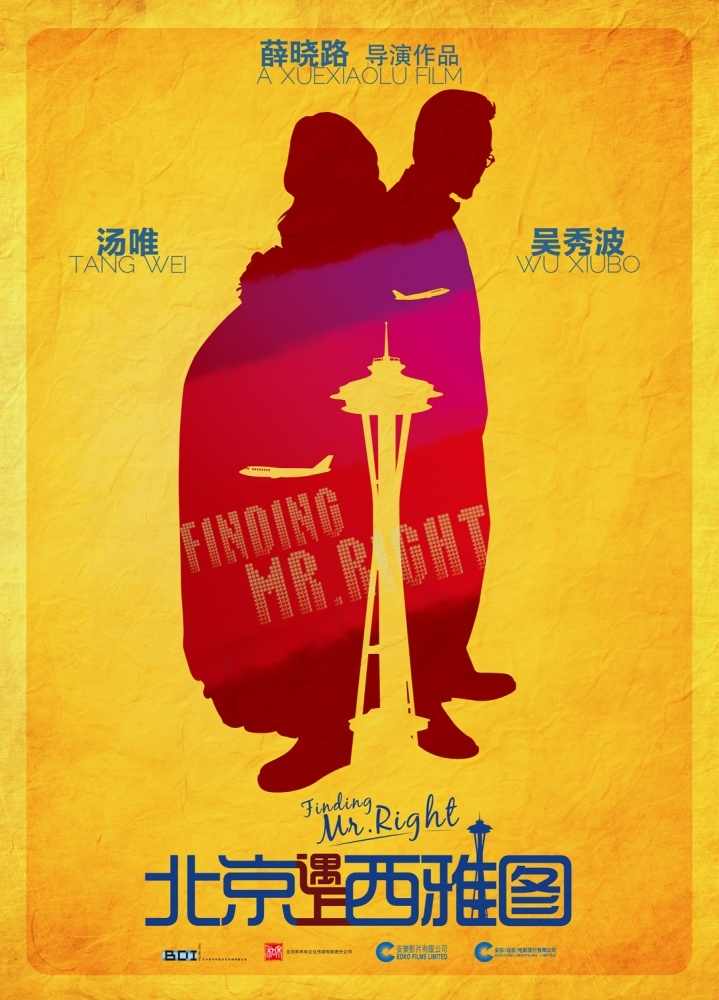
This post is devoted to Tang Wei's latest project, "Finding Mr. Right" (literally "Beijing Meets in Seattle"). Tang Wei co-stars with Wu Xiubo, primarily a TV actor. It's a romantic comedy by director Xue Xiaolu.
Tang Wei plays Wen Jiajia the girlfriend of a rich boyfriend. Wu Xiubo is, Frank, a single father with a young daughter. Frank and Wen Jiajia accidentally meet on Christmas Eve after the boyfriend disappears leaving Jiajia in dire straits, i.e., without money. Frank looks after the Jiajia and then develops feelings for her. Later, Jiajia returns to China and gives birth to a child and renews her luxurious life when the boyfriend resurfaces and they marry But Jiajia misses Frank and becomes a single mother. Two years later, Frank and Jiajia have a romantic reunion in the United States. Sound much like "Sleepless in Seattle"? (Douban.com)
Below, a recently released concept poster and some promotional stills. Look for a March release.
Here’s a movie that China doesn’t want you to see. It’s a marvellous work of cinematic art, but it’s also a horrifically fascinating and deeply poignant view of a non-independent judicial system at work: its subject, in effect, is procedural injustice. “When Night Falls” is directed by Ying Liang—whose work I’ve written about here often; he’s one of the world’s best young filmmakers—and it doesn’t yet have U. S. distribution. As I mentioned in May, before I had a chance to see the film, the Chinese government took stern steps against the movie and its director at the time of its première at the Jeongju Film Festival, attempting to purchase the film (the better, of course, to suppress it), subjecting the filmmaker’s family to interrogations, visiting the filmmaker (who is now essentially in exile in Hong Kong) in the hope of persuading him to change it, and threatening him with arrest should he return home.
It’s a fictionalized account of a true story, concerning a young man, Yang Jia, who was convicted, in 2008, of stabbing and slashing six police officers to death. Later in the year, he was executed. The background to these incidents (or accusations) concerns Yang’s arrest for riding an unlicensed bicycle; he charged that he was beaten in police custody and his attempts to bring charges or seek other redress were rejected. After Yang’s arrest, he became (according to the filmmaker Edmund Yeo) “a hero among many Chinese.” Meanwhile, his mother, Wang Jingmei, was—as soon as she was informed of his arrest—hustled off to a mental hospital, compelled to sign official documents against her will and better judgment (and without benefit of legal counsel), and held there for a hundred and forty-three days. Then she was hustled off again to the prison where her son was being held. After a brief visit with him, she was sent home to Beijing.
The first ingenious twist to Ying’s movie is that it focusses on the mother of the accused, played by the actress An Nei, and looks closely at her actions and experiences in the two days following her release, when all of her time and energy went to her efforts to help her son (who is not a dramatized character in the film and is only seen in still photographs). Ying depicts the immediate interest of activists in the case, one of whom reveals that Ai Weiwei posted about the case and explains that many “netizens” are among her supporters. Another activist turns up with a video camera to chronicle Wang’s confrontation with the legal system (even bringing it to the courtroom in which two judges announce the order for Yang’s execution) and declares that the judicial proceedings are a mere cosmetic to mask state crimes.
Ying is fascinated by the functioning of law in China. His second feature, “The Other Half,” is centered on a provincial law office, where the documents that cross the protagonists’ desk offer a sense of the roiling chaos beneath the official surface of order. (It’s distributed here by dGenerate Films, an indispensable source for contemporary Chinese independent films as well as for information about the film, the filmmaker, and his recent travails.) In “When Night Falls,” Ying’s direction is even more severely controlled and precise; it’s as if his tensely concentrated attention to Wang and the minutiae of her quest, including her carefully handwritten legal filings and her quest to photocopy and mail them, calls more clamorous attention to the entire silenced world of political pressure, manipulations, decisions—the entire dehumanized yet despicably human mechanism of power—to which she and her son are subjected.
There’s a brilliant shot, midway through the film, in which Wang returns home after the courtroom session and simply wants to be alone. Ying’s camera stays low in the hallway of her building, watching through the bannister rails as she and her supporters troop up the staircase. By not following them, but merely continuing to gaze at the empty space they’ve passed through, he captures their harsh and poignant dialogue on the soundtrack (“What’s wrong with this society?” “This case is relevant to the future of the People’s Republic of China’s legal system”), as if to highlight more intensely its universal import.
The facts of the case are well known; it’s no spoiler to say that, despite Wang’s efforts, her son was executed, and the scene in which Wang learns this is a quiet masterpiece of imagination. Her gestures—drinking from a teapot, tearing leaves from a calendar—have both a spontaneous nobility and a futile comedy that are as grand and as poignant as a scene from Griffith. “When Night Falls” is a work of memory, reconstruction, and empathy that blends a coolly analytical style with a fierce yet quiet passion. Its precise and intimate scope, its canny sense of refracted representations, turns its lightly idealized modernism into a powerful version of political documentary. No wonder the Chinese government is unhappy with it.
When the movie was shown this summer at the Locarno Film Festival, Ying won Best Director and An won Best Actress. It’s surprising that the movie didn’t turn up here at the New York Film Festival; it’s vastly superior to the one Chinese film (“Memories Look at Me”) that was screened there. I hope that “When Night Falls” finds American distribution soon, and that it finds its place onscreen here, and in history—and that its director, Ying Liang, remains both safe and productive. New Yorker




 Posts
Posts


